The serious scarcity of Defence data

An article, ‘Repeat deployments ‘good for diggers’‘, in this morning’s The Australian detailed a departmental submission to the Defence Personnel Minister addressing concerns over repeated deployments of Australian Defence Force (ADF) personnel. According to the article, Australian studies showed a positive yet “not statistically significant” relationship between deployment and mental health indicators. Obtained by The Australian via Freedom of Information laws, it is worth examining the information supporting such a view, contained in the unclassified submission ‘Multiple Operational Deployments – Effects on Australian Defence Force Members’ (PDF), linked to from the article.

The main finding: the information supplied to a Minister informing him of the mental health effects of repeated deployments on the ADF was woefully lacking in comprehensiveness and detail.

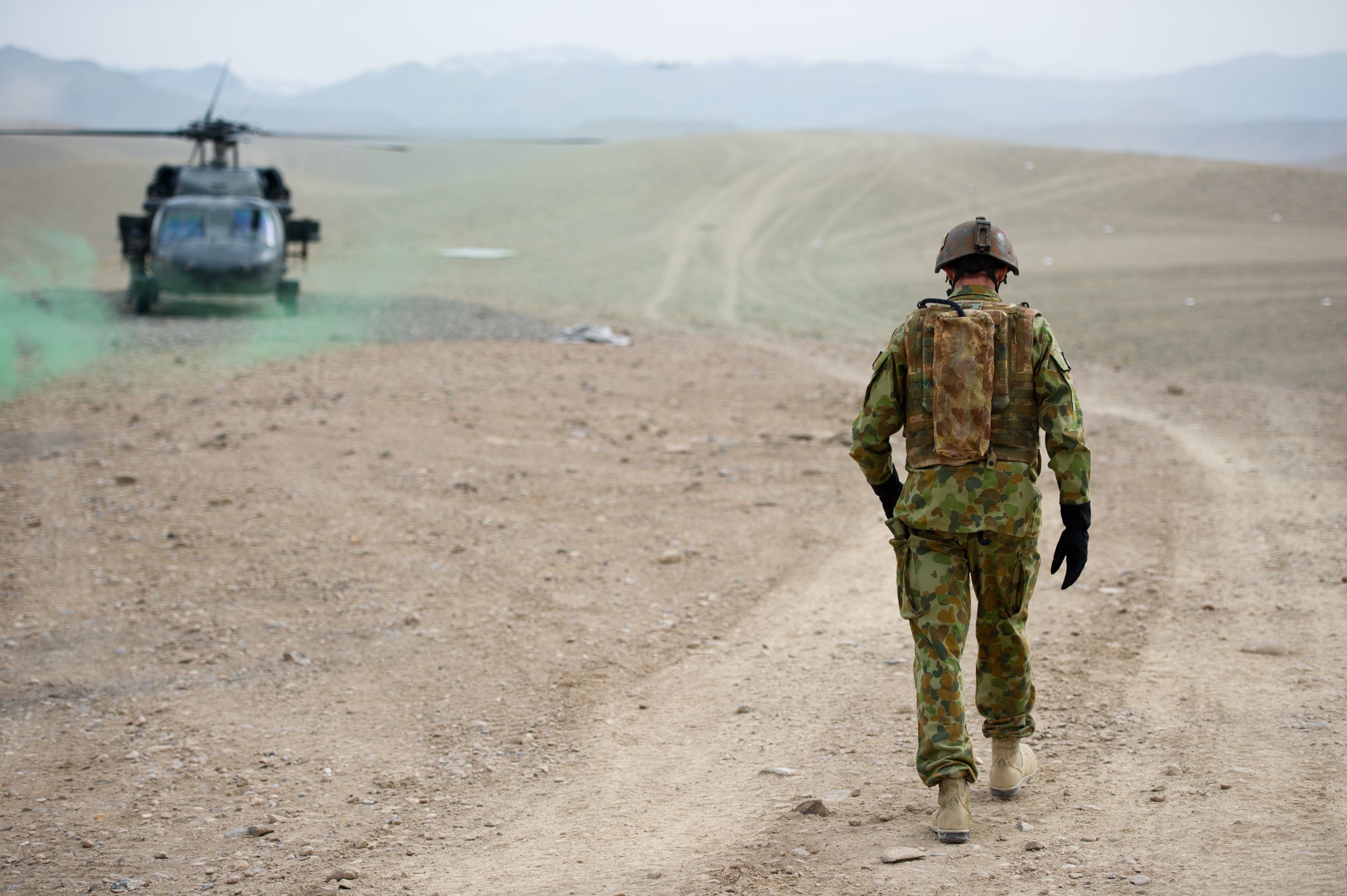
First, only one Australian study (Curtis 2008) on the ADF mental health and repeat deployments was supplied. Research supporting the study was conducted between 2002 and 2007. At the time the submission was drafted, another study was being finalised, yet when considering the 11 years Australian forces have been in Afghanistan, from this submission there is seemingly an alarming dearth of information from which a proper appraisal of the effects of repeat deployments can be made.

Second, the information to the Minister did not disaggregate certain groups such as special forces. In the case of Afghanistan, as reported in yesterday’s press, the Special Operations Task Group (SOTG) is involved in high-tempo operations such as Operation TEVARA SIN 24 which involve difficult tasks such as the targeting and killing of insurgents. With many having already completed multiple deployments since October 2001 (Defence, PDF), their experiences in the AfPak theatre in particular should form an important basis for the Minister’s consideration of the human effects of such conflicts.

Third, if there were no other studies available, it must be asked, what must be done to collect, analyse and disseminate data to Defence decision makers quickly and efficiently? While another study on the frequency and duration of ADF deployments has since been published, academic publication channels are admittedly slow. Therefore, in circumstances such as warfare in which time lapses have significant ramifications for those in-theatre, what can be done to produce relevant and timely information without compromising its integrity?

That our Ministers are provided such limited information with which to make decisions on matters such as deployments is a matter of concern. That the submission is unclassified is immaterial. If repeated deployments have significant mental health effects, they should be made known to the public. Together with informed debate on the strategic and political gains of engaging in such conflict, information on the effects of deployment must form part of the Australian public’s and Government’s consideration of conflicts such as Afghanistan. Hopefully, it is not too late when we understand what the costs of our departmental and even media-muteness on this side of warfare has been.
Will Australia go to war in Libya?

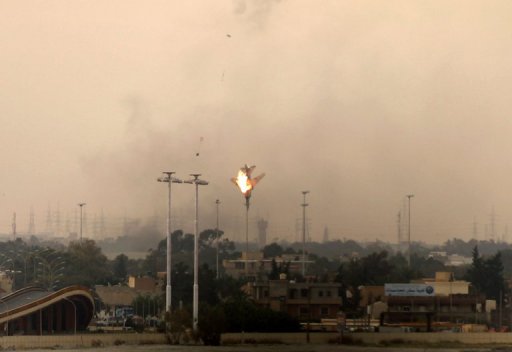
As I write this, my RSS feeds and Twitter timeline tick over with reports of fierce fighting between Libyan and rebel forces, news of the Paris summit for world leaders, and speculation on the fighting to come. Gaddafi has undeniably broken his own ceasefire. A Libyan warplane has been shot down. This will get messier still with the involvement of foreign forces, not only from enforcing a no-fly zone but also from the ground level troops required to provide tactical intelligence in support of air assets.

With Britain, the US, Canada, France, Spain, Denmark and the UAE readying their fighter jets for the Mediterranean, I can’t help but wonder when Australia’s military will be dragged into the fight for Libya.

Foreign Minister Kevin Rudd today ruled out the possibility of RAAF aircraft being used to enforce the no-fly zone, however I’m still not convinced that denies future involvement of Australian forces in other Libya-related operations. The Australian public would be forgiven for resisting the thought of sending our troops on other far-flung coalition conflicts, but best we consider the possibility now, and there are a couple.

The first and most likely of these scenarios involves Australian troops deployed as a part of an international stabilisation force after Gaddafi’s forces are pushed back swiftly. Both Foreign and Defence Ministers Rudd and Stephen Smith are correct in pointing out that this is a matter ostensibly for NATO, however, as part of a UN or coalition mission, Australia may be requested to send troops.

The second and more ominous scenario envisages a more protracted engagement with NATO and other foreign troops. President Obama will have to make good on his promise that military action will ensue if a cease-fire is not immediate; given Gaddafi is currently pushing into Benghazi, I’d say the President has few choices. While President Obama has asked for military action to exempt ground forces and be “finite”, there is still the possibility that the situation in Libya could take a turn for the worst. The UN resolution, based on Chapter 7 provisions on the responsibility to protect, mandates the protection of Libyan civilians; the door is left open for a more active intervention. In this scenario, although considerably less likely, Australian troops may contribute a small contingent for heavier fighting and more surgical tasks.

While crystal-ball gazing is an undertaking fraught with danger (and I’m happy to be wrong on these points), perhaps the Australian public, wary of political underselling of conflicts such as Afghanistan, should begin considering whether some 70 years later there might be a second coming of the Rats of Tobruk.

Photo courtesy of AFP.

Australian FETs in Afghanistan?

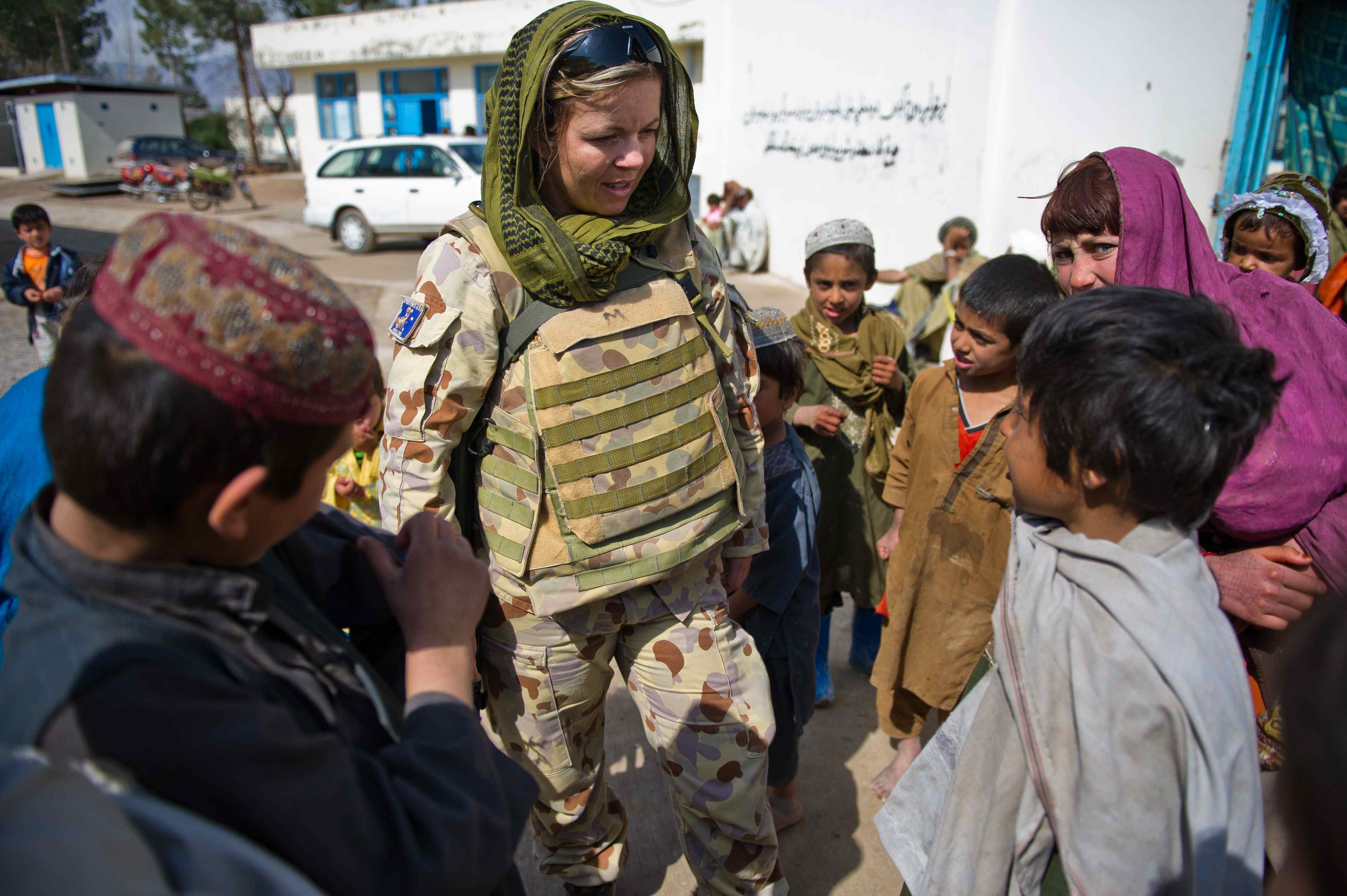
Last month, I wrote about Female Engagement Teams operating in Afghanistan, comprising American and British troops. Like their NATO counterparts, female Australian troops have been deployed to Uruzgan province and, as part of the Provincial Reconstruction Team mission, they also engage with Afghan women and children. Yet little has been reported about formal Australian arrangements that mirror FET, perhaps until now.

As part of recognising International Women’s Day, the Defence Department posted a short write-up of female ADF participation in Uruzgan province. The media release began by introducing FET as ISAF’s lead initiative in engaging women and facilitating development programs before turning to Australia’s bit.

While the media release’s build-up left the ostensible expectation that Australia was engaged in FET-like activity, it only linked FET to PRT in stating that work was done in “close conjunction” and that one PRT member had participated in a FET with a female interpreter.

While it is commendable to see more Australian female involvement in the military, especially in Afghanistan, that the bulk of this write-up consists of largely other nations’ initiatives (and our fleeting engagement with them) is rather sad. It exposes a lack of creativity in utilising our female personnel. Some may argue that our contribution of 1,550 is modest and, thus, does not necessitate a prominent female program. However, I would argue that is not the point. We have female personnel in Afghanistan and if we wish to promote in particular their ability to engage with Afghan women, let’s not wait until International Women’s Day and only do so on such an ad hoc basis.

Photo of Captain Sarah Vesey (JTF HQ) in Tarin Kot, courtesy of the Department of Defence

Afghanistan’s War Dogs: the good, the bad and the ugly

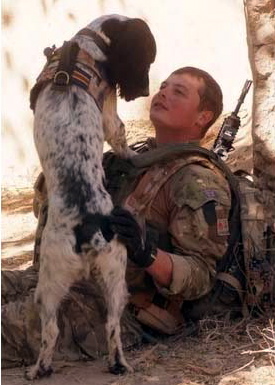
Photo courtesy of UK Forces Afghanistan

Lately, there have been a few stories about dogs in Afghanistan. One of the most touching has been that of British IED-detection dog Theo (pictured right) who allegedly died of a broken heart after his master, Lance Corporal Liam Tasker was shot in action this week. Animals are a welcome inclusion in the narrative of the Afghanistan conflict. Even sad stories such as Theo’s illustrate the selflessness, stoicism and loyalty of dogs on duty. Dogs can be a good news story that lift (or distract) public sentiment about a conflict.

Yet sometimes, the good tends to overshadow the reality of a dog’s life in war zones. In this post, I wanted to explore not only the good, but also the bad and ugly of life for man’s best friend in Afghanistan.

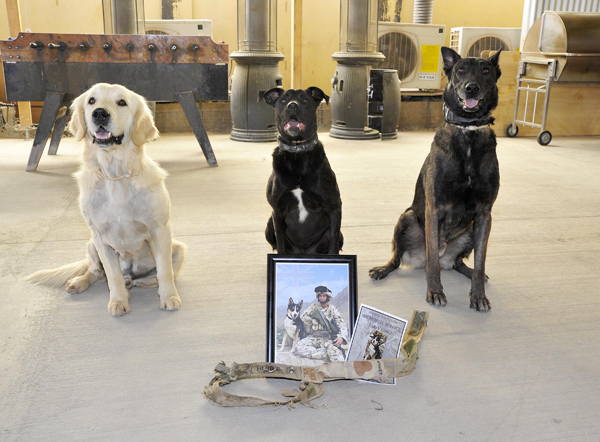
Photo courtesy of Department of Defence

The Bad. First, there are obvious physical risks to dogs deployed to combat zones, and many, like Theo, do not come home. Some die not just from wounds sustained in explosions—one of the vicissitudes of their line of work—but also from heat stroke, friendly fire, being run over, or, in the case of one US hero, being accidentally put down. Australia’s most recent canine casualty was Herbie (whose mates are pictured left, attending the memorial service of their fallen comrade in Uruzgan), killed alongside his handler Sapper Darren Smith in Afghanistan last year.

Second, the danger is ever increasing; now it appears the Taliban are offering bounties to snipers for killing dogs and their handlers, leaving their patrols vulnerable to explosives and no doubt, diminishing morale in the process and scoring a PR win.

Once their deployment(s) is over, these dogs are cared for in hospitals (examples include the Defence Animal Centre in the UK and Holland Military Working Dog Hospital in the US) or, if they are lucky, adopted.

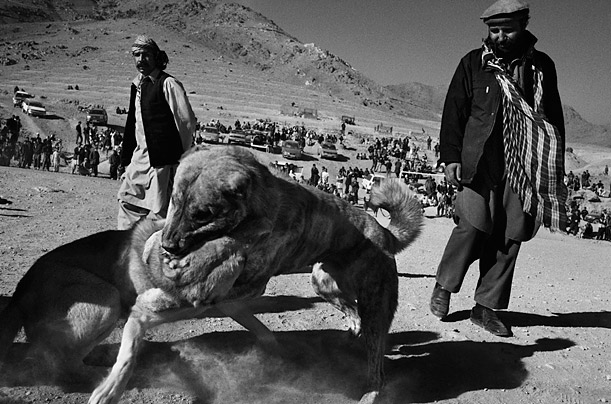
Photo by Lorenzo Tugnoli, TIME

And the Ugly. The plight of ordinary Afghan dogs, relative to their military counterparts, is a secondary consideration; a foreign media curiosity at best, a problem too hard to solve at worst. Sure, they’re not actively protecting soldiers and dismantling insurgent threats but they too are caught up in a post-9/11 Afghanistan.

Despite being banned under the Taliban, the practice of dogfighting in recent times seems to have flourished (incidentally, their ability to draw crowds has made them a popular target for recent bomb attacks). Although not supported by all parts of Afghan society, owners defend the practice, arguing that the dogs are well fed and, unlike in other countries, the dogs are pulled apart and not fought to the death.

What does the case of Afghanistan tell us about how we value these animals? Military or “civilian”, the case of dogs in Afghanistan shows that, at the end of the day, dogs are a cog in the machinery of man’s life. Sometimes they pay the ultimate sacrifice whether we wage war or win wagers. Their further make their contribution as a part of the propaganda campaign of conflicts: the timing of announcing Sarbi’s return with then Australian PM Kevin Rudd’s visit to Afghanistan was not lost on the Australian media. Given the dearth of information on Afghanistan, why not a good news story about a long lost canine?

While womens’ rights are currently being compromised to further peace talks in Afghanistan, I am pessimistic about animals’, particularly dogs’, rights there. In any case, we should take a moment to respect the lives and contributions of war dogs everywhere. After all, for many, it truly is a dog’s life.

Post script: More more on war dogs, please see War Dog of the Week on Tom Ricks’ blog. For further information on Military Working Dogs in the ADF, please see the Australian Defence Force Trackers and War Dogs Association. For further information on animal welfare groups in Afghanistan, please see Nowzad Dogs.


The problem with defence journalism


I nearly choked on my cup of tea whilst reading Ian McPhedran’s report of the latest Victoria Cross recipient Special Air Service Regiment (SAS) soldier, Corporal Ben Roberts-Smith, in last week’s Daily Telegraph. McPhedran carefully set the scene:

The brown dust from the departing choppers that carried the SAS squadron south from their base at Tarin Kowt had barely cleared when all hell broke loose. It was October 2010, at the height of the Afghanistan fighting season, and a large Taliban force had established numerous firing positions around heavy machineguns. More than 24 elite Perth-based Diggers from the Special Air Service Regiment were under withering fire. Realising his mates were in grave danger, and with no regard for his own welfare, the SAS Corporal charged headlong into the Taliban machinegun fire. The sight of the 202cm Australian warrior coming at them must have shocked the bearded Afghans.

It was a little more action-packed than your run-of-the-mill defence article, but I was still sipping at this stage. However, what I was about to read next—an excerpt from an earlier battle during which Corporal Roberts-Smith earned his 2006 Medal for Gallantry—put me off my Earl Grey:

During that fight, according to comrades, “RS” tore a Taliban fighter off his back like an insect, stood on his throat and shot him dead.

I didn’t know whether to laugh or cry.

Reporting on the conditions facing members of the Special Operations Task Group (of which the SAS is a part) is a necessary part of painting a picture of the war in Afghanistan for the Australian public. On the other hand, against a context of information scarcity on the conflict, the sexed up nature of McPhedran’s description was uncomfortably magnified.

I wish to make clear that my issue with McPhedran is not ad hominem. My issue is with the lack of consistent and informative reports available about the ADF in Afghanistan, brought to light by the nature of McPhedran’s article.

Defence’s tight grip on information flow has been striking and to its detriment. In July of last year, journalist Chris Masters imparted to an audience at the Lowy Institute the frustrations involved in trying to report on ADF activity. In November, Prakash Mirchandani pointed out an inconsistency in Defence’s stance on Wikileaks by highlighting the conflicting opinions of two frontline young officers interviewed by an embedded journalist and the Minister for Defence Stephen Smith. The same month, Monash University held a conference on information warfare during which it was revealed Australia was the most restrictive in providing access to defence correspondents in Afghanistan.

I cannot help but think that this lack of public information in turn stifles real discussion about our commitment, leaving us with only McPhedran-style action-packed postcards and, more alarmingly, lackluster parliamentary debate (see Prime Minister Julia Gillard’s opening speech here and Opposition Leader Tony Abbott’s here).

We owe it to the Australian public and to members of the ADF to depict an honest and comprehensive picture of Afghanistan. The mental image of an SAS soldier with his foot on the throat of an enemy is a rather confronting one. It would be a shame if it turns out to be the most striking.

Postscript: For those of you interested in reading about the SAS, let me steer you first towards In Action with the SAS by military historian David Horner, before pointing out McPhedran’s books, The Amazing SAS and Soldiers Without Borders: beyond the SAS. Or, Matthew Reilly.

See also, our related article ‘Losing the narrative battle: civilian deaths and Defence PR‘.

Photo courtesy of Department of Defence

Linking Matiullah Khan to Kabul

On 16 December, the Obama administration released its annual review of the strategy in Afghanistan and Pakistan. The Obama review highlights the progress made in depleting al-Qaeda’s leadership and breaking the Taliban’s momentum, and underscores the challenges of combating corruption, eliminating Pakistani sanctuaries and transferring responsibility to Afghan security forces.

In response, the Australian Defence Minister Stephen Smith noted that it was an “important opportunity to assess whether the implementation of the Afghanistan-Pakistan strategy and the transition to Afghan responsibility for security is on track.” His statement, however, concentrated on Australia’s efforts, as part of the international community, to improve governance and address corruption.

This statement reiterates our desire to support legitimate and transparent government at the national level, yet it remains disjointed from our undertakings in Uruzgan. Of these undertakings, our continued support of local warlord Matiullah Khan remains a perennial concern. While our cooperation with Khan has been defended by our military leadership as a relationship of necessity, he is a controversial figure, one with whom even the Dutch refused to work. This status quo is problematic. There remains no clear strategy that articulates the nexus between local governance structures and national ones. Several months ago, Tom Hyland (amongst others) raised concerns about our engagement of Khan in terms of its undermining of the capacity of the Afghan government. Despite calls for greater transparency in our dealings in Afghanistan and more open debate, we are still without a roadmap that links Khan to Kabul.

Compounding the problem is our Government’s lack of confidence in working with provincial level leaders; a Wikileaked cable shows Prime Minister’s Gillard’s call for Afghan President Karzai to remove the governor of Uruzgan owing to corrupt and obstructionist behaviour. While this may seem to affirm our stance on anti-corruption, it is a reminder that we are dealing with a plethora of uncertain and difficult actors. The lack of reliable partners must surely serve to undermine efforts at consistent and durable reform.

With all this talk of the 2014 handover date, there remain some hard questions to be considered. Without a clear linking strategy, how do we reconcile our desire to bolster the Government of Afghanistan with our continued support of local warlords? How do we reconcile our lack of confidence in Afghan partners with our desire to handover to Afghan civilian and military officials once we leave? Without consideration to these questions, once we withdraw, there will be few guarantees that our actions will not create more problems than the security benefits we set out to achieve.